The True Cost of Your Patchwork Hotel Tech Stack
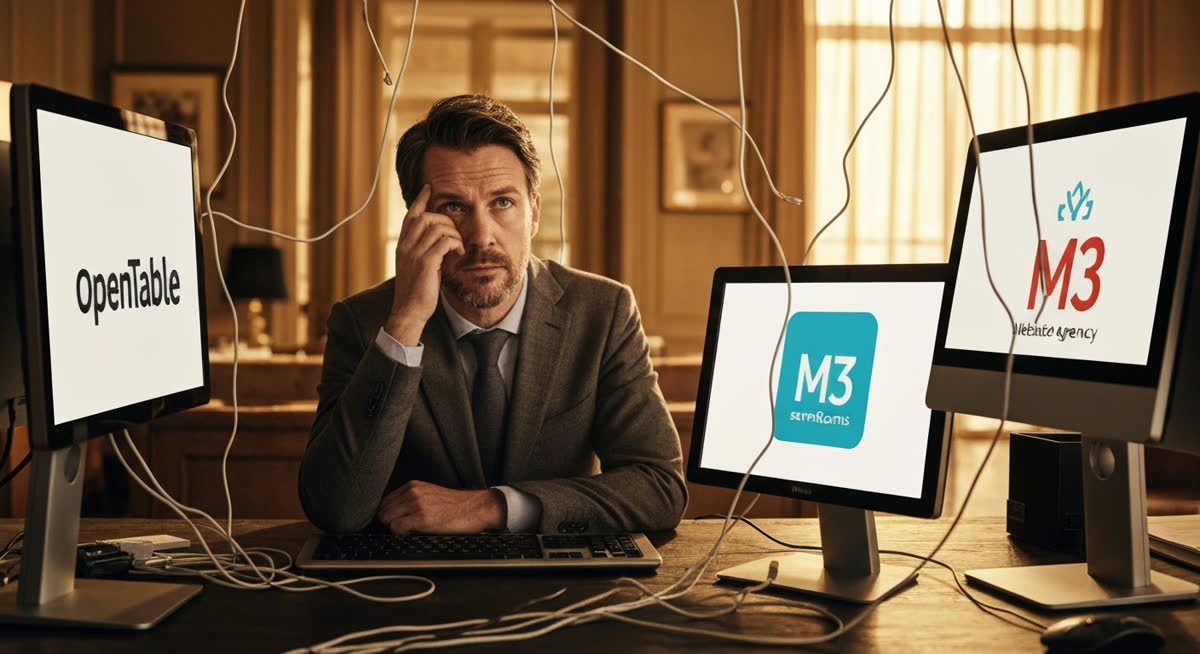
In the bustling world of hospitality, efficiency and guest experience are paramount. Yet, many luxury properties are unknowingly bleeding resources and compromising service due to a common culprit: the patchwork hotel tech stack. You know the drill – Toast for POS, OpenTable or SevenRooms for F&B reservations, M3 for accounting, and a separate agency managing your website. Each a "best-in-class" solution, perhaps, but together, they often create a Frankenstein's monster of disconnected systems.
This isn't just about subscription fees. The true cost extends far beyond monthly invoices, manifesting in hidden labor, lost revenue, and a fractured guest journey. It's time to pull back the curtain on what running this disparate collection of vendors actually costs your property each year.
What is the actual annual expense for disconnected hotel tech?
Let's break down the direct costs of these popular, yet siloed, solutions. While exact figures vary based on property size, volume, and negotiated contracts, we can paint a clear picture of the financial commitment.
Toast POS: More Than Just Transactions
Toast is a dominant player in restaurant POS, often extended to hotel F&B operations. While some plans offer "pay-as-you-go" with no upfront monthly fee, these come with higher payment processing rates (e.g., 2.99% + 15¢ per transaction). Their "Point of Sale" plan, more common for full-service operations, can start around $69 per month for software, plus hardware costs (which can range from $799 to over $1,500) and additional payment processing fees (e.g., 2.49% + 15¢). Add-ons for online ordering, loyalty, or marketing can quickly push monthly software subscriptions into the $400-$500 range. For a busy hotel restaurant, these transaction and add-on fees can easily accumulate to thousands of dollars annually, not including installation fees ($250+) or ongoing support contracts.
OpenTable & SevenRooms: The Reservation Tug-of-War
For F&B reservations, many hotels rely on either OpenTable or SevenRooms. OpenTable for Restaurants offers tiered pricing, ranging from a "Basic" plan at $149/month to a "Pro" plan at $499/month, as of early 2026. Critically, OpenTable also charges per-cover network fees, typically $1 to $1.50 per diner booked through their network, plus a 2% service fee on transactions like deposits. For a 100-cover restaurant doing 2,500 covers a month with 60% from the OpenTable network, monthly costs could be upwards of $1,799-$2,649.
SevenRooms, on the other hand, positions itself as an all-in-one hospitality CRM and operations system. While they often don't publish pricing directly, their core platform for a single venue can start around ~$499/month, with a full suite including marketing and WhatsApp integrations potentially reaching $600-$900/month. SevenRooms generally boasts zero per-cover fees on direct bookings, which can be a significant differentiator from OpenTable, especially for high-volume venues. However, some contracts may still include per-cover fees on top of their base subscription. The choice between these two often becomes mutually exclusive, as OpenTable ended its two-way integration with SevenRooms in 2025.
M3: The Accounting Backbone
M3 is a specialized financial management platform for the hospitality industry, designed to handle complex accounting, budgeting, payroll, and compliance. While M3's pricing isn't publicly available and is often customized based on factors like the number of rooms and integrations, some sources suggest a starting point around $150/month per user. For a mid- to large-sized hotel with multiple accounting staff, this can translate to thousands of dollars annually in subscription fees alone, before considering implementation or specific integration costs.
Website Agency: Your Digital Shopfront
A hotel's direct booking website is crucial, and most properties work with a dedicated agency. The cost for a custom-designed, responsive, and SEO-friendly hotel website typically starts around $7,000, but can range from $10,000 to $60,000 or even higher for complex enterprise-level platforms. Beyond the initial build, annual maintenance and support costs can range from $1,000 to $5,000, covering updates, backups, and security. Domain names and hosting add another $100-$500 annually. SEO and content services might add another $500-$2,000 per month. These ongoing costs quickly add up, easily reaching five figures each year.
Beyond the Invoice: The Hidden Costs of Disconnected Hospitality Software
The direct fees are just the tip of the iceberg. The real financial drain of a patchwork tech stack lies in its hidden costs, which erode profitability and hinder growth.
Labor Inefficiencies & Operational Friction
When systems don't talk, your staff becomes the integration layer. Manual data entry, cross-referencing information between Toast, OpenTable, M3, and your PMS, and reconciling discrepancies are daily realities. This isn't just frustrating; it's a massive time sink. Hotel teams in the UK and Ireland, for example, lose approximately 286 hours per year—roughly seven working weeks—switching between incompatible platforms. This time is spent on manual data reconciliation, duplicate entry, and chasing information, rather than on guests. This inefficiency directly translates to higher labor costs and decreased productivity.
Data Silos & Lost Guest Insights
The "spaghetti-like" network of disconnected applications means guest data is scattered across multiple systems. A guest's F&B preferences in Toast don't automatically inform the front desk via the PMS, or the marketing team leveraging SevenRooms' CRM capabilities. This fragmentation prevents a unified, 360-degree view of the guest, limiting personalization opportunities. Hoteliers struggle to access the data needed for revenue and operational decisions, with disconnected systems being a primary obstacle. Studies show that personalization, enabled by unified customer data, can increase total revenue by 5–15% and marketing ROI by 10–30%. Without it, you're leaving money on the table.
Integration Nightmares & Vendor Blame Games
Each vendor promises "integrations," but the reality is often complex and costly. Basic integrations might be included, but advanced or custom API development can add thousands of dollars to implementation costs. These aren't set-it-and-forget-it solutions; they require ongoing maintenance, troubleshooting, and often, the unenviable task of getting two different vendors to resolve an issue that lies in the "middle ground" between their systems. This creates IT headaches, delays, and further drains resources.
Compromised Guest Experience
Ultimately, a disjointed tech stack impacts the very core of hospitality: the guest experience. Imagine a loyal guest whose preferences are stored in a CRM but aren't accessible to the front desk, leading to a missed opportunity for personalized service. Or receiving irrelevant marketing emails because guest profiles are duplicated across multiple databases. These small failures accumulate, making guests feel undervalued and less likely to return. In an era where 61% of consumers are willing to spend more for a customized experience, but only 23% report high levels of personalization after hotel stays, the disconnect is clear and costly.
Is there a better way to manage hotel technology?
The competitive landscape of 2026 demands a shift. The future belongs to hotels that embrace unified systems. Instead of a patchwork of point solutions, imagine a single platform that natively integrates POS, reservations, guest CRM, direct booking, and accounting ERP. This is the promise of vertically-integrated software like Hospitality360.
With a unified platform, data flows seamlessly across departments, providing a real-time, 360-degree view of every guest. This eliminates manual data entry, reduces errors, and frees up your staff to focus on what they do best: delivering exceptional service. Imagine personalized upsell opportunities driven by actual F&B spend, marketing campaigns targeted with precision, and accounting data that reflects real-time operational performance, all without the hidden costs of integration or the frustration of fragmented information. This simplification isn't just about cost savings; it's about unlocking new revenue opportunities, enhancing decision-making, and delivering the truly seamless, personalized guest journeys that define luxury hospitality.
The true cost of your patchwork tech stack is far greater than the sum of its invoices. It's the cost of missed opportunities, frustrated staff, and a guest experience that falls short of its potential. Moving to a unified platform is not just an upgrade; it's a strategic imperative for profitability and exceptional hospitality in the modern era.
One-sentence takeaway: Consolidating your hotel's disparate tech systems onto a single, unified platform is no longer a luxury, but a vital strategy to eliminate hidden costs, empower staff, and deliver truly exceptional guest experiences.
See how Hospitality360 replaces Toast, OpenTable, SevenRooms and M3 with a single source of truth.
Explore the Platform